

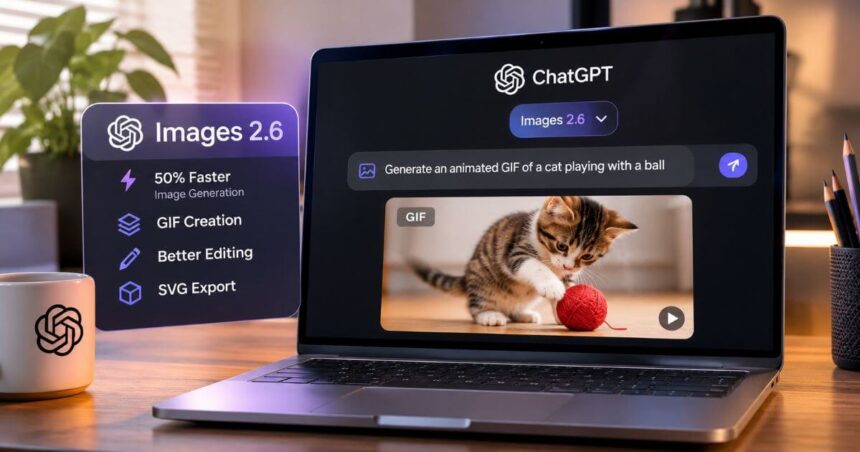
OpenAI has introduced Images 2.6, its latest image-generation update, bringing several improvements to ChatGPT, Codex and its API. The new release focuses on faster image generation, better editing capabilities and more control over the final output. However, the biggest addition is the ability to create animated GIFs using AI-generated images.
With Images 2.6, users can turn characters, product photographs, sketches and other visuals into short animated loops. OpenAI has also worked on maintaining consistency across multiple editing rounds, making it easier to refine an image without repeatedly changing important details.
The company says Images 2.6 generates images 50% faster than its predecessor. Let’s take a closer look at its new features, developer tools, pricing and availability.



OpenAI Images 2.6 Brings 50% Faster Image Generation
Images, upgraded—introducing ChatGPT Images 2.6.
Now with GIFs and reference images.
Plus, two new models are coming to the API with 50% faster image generation. https://t.co/kcuOhTipYR
— OpenAI (@OpenAI) November 4, 2026Speed is one of the biggest improvements in Images 2.6. OpenAI says the new model generates images 50% faster than before, allowing users to experiment with more ideas and make changes without spending as much time waiting for results. The update also focuses on professional-quality visuals. It aims to preserve important details such as characters, products and brand elements when users make successive edits.
This can be particularly useful for designers, marketers and businesses working on product images, promotional posters, social media creatives and advertising campaigns. OpenAI has introduced two API models for developers: GPT-Image-2.6 Flare and GPT-Image-2.6 Sunburst. Both serve different creative requirements.
Flare is designed for faster image generation and improved layouts. When the quality setting is set to low, it can generate an image in as little as six seconds. It is particularly suited to posters, product imagery and other professional visuals where speed matters. Sunburst, on the other hand, focuses on greater detail and precision. OpenAI says it offers higher-quality image generation and improved consistency across editing rounds when the quality setting is medium or high.
ChatGPT Images 2.6 Can Now Create Animated GIFs
GIF creation is arguably the most interesting addition to Images 2.6. Users can now bring static visuals to life by turning characters, mascots, product images and sketches into animated loops. For example, a business can animate its brand mascot for a promotional campaign. Content creators can generate reactions and memes for social media, while designers can experiment with character movements through animated storyboards before moving towards video production.
Users do not necessarily need to begin with a finished illustration. OpenAI says even a simple sketch can be turned into an expressive animated character for videos, games and other creative projects. This could make AI-generated GIFs useful beyond entertainment. Businesses and creators can use them for marketing, product demonstrations, online communication and social media content.
Better Image Editing With Markup And SVG Exports
We have a gif for you—ChatGPT Images 2.6 is here.
ChatGPT Images 2.6 can turn your prompts and pictures into animated GIFs.
You can also keep reference images of yourself, pets, and characters ready to reuse in new creations…no need to upload them again.
Go on. Make it weird. Send more GIFs of your dog dancing.
Images 2.6 is available today in ChatGPT, and Codex across all tiers on web, desktop, and mobile.
https://t.co/WQg0cVJRca
— ChatGPT (@ChatGPT) November 5, 2026Images 2.6 also brings improvements for developers who need more control over image editing. One important addition is image markup support in the API. The feature was already available in ChatGPT, and developers can now use it to identify specific areas of an image where changes are required.
Instead of describing an entire image again, teams can point out the exact section that needs modification. This should make editing workflows more precise, especially when working with detailed designs or product visuals.
Another major addition is SVG export support. SVG files can be useful for websites, applications and print projects because they are scalable graphics. This gives developers and design teams another way to take AI-generated visuals into their existing creative workflows.
OpenAI has also introduced a new complexity parameter. It allows developers to control how much planning the model applies before generating or editing an image. For routine editing tasks, OpenAI recommends using low complexity for faster results. Images containing multiple elements, detailed compositions or several constraints may benefit from medium or high complexity settings.
Image quality and complexity are separate controls. Quality determines the visual detail and fidelity, while complexity controls how much planning goes into the requested scene.
OpenAI Images 2.6 Pricing: How Much Does It Cost?
Images 2.6 is available through ChatGPT and Codex across all subscription tiers. OpenAI has not announced a separate consumer price for using the feature in ChatGPT. The availability of the feature should not be confused with unlimited usage, as the announcement does not specify new plan-wise generation limits.
For developers, GPT-Image-2.6 Flare and Sunburst are available through the API. OpenAI charges based on token usage rather than a single fixed price for every generated image. The official API pricing lists the following rates:
| API Model | Image Input | Image Output | Cached Image Input |
|---|---|---|---|
| GPT-Image-2.6 Flare | $8 per 1M tokens | $30 per 1M tokens | $2 per 1M tokens |
| GPT-Image-2.6 Sunburst | $8 per 1M tokens | $30 per 1M tokens | $2 per 1M tokens |
Text input is priced at $5 per 1 million tokens, while cached text input costs $1.25 per 1 million tokens. The API pricing page also lists lower Batch rates. For both models, image input costs $4 per 1 million tokens, image output costs $15 per 1 million tokens, and cached image input costs $1 per 1 million tokens. Batch text input costs $2.50 per 1 million tokens, with cached text input at $0.625 per 1 million tokens.
These are token-based rates, not fixed prices per image. The actual cost depends on the amount of image and text tokens used. Developers can use OpenAI’s image generation cost calculator to estimate their usage.
OpenAI Images 2.6 Availability
| Specifications | Details |
|---|---|
| Model Name | OpenAI Images 2.6 |
| API Model Variants | GPT-Image-2.6 Flare and GPT-Image-2.6 Sunburst |
| Primary Capabilities | AI Image Generation, Image Editing and GIF Creation |
| Image Generation Speed | 50% faster than the previous generation, according to OpenAI |
| Fastest Generation | Flare can generate an image in as little as 6 seconds at low quality |
| Flare Model | Optimised for faster generation, quick editing and improved layouts |
| Sunburst Model | Designed for detailed visuals, precision and better consistency across edits |
| Input Support | Text Prompts and Images |
| Editing Features | Markup-Guided Editing and Improved Character, Product and Brand Consistency |
| Complexity Controls | Low, Medium and High |
| Image Quality Controls | Low, Medium and High, with additional API quality options |
| Supported Output Formats | PNG, JPEG, WebP, SVG and Animated GIF through the API |
| GIF Generation | Supports animated GIF creation with configurable frames and animation duration through the API |
| SVG Export | Supported through the API |
| Availability | ChatGPT, Codex and OpenAI API |
| Platform Support | Web, Desktop and Mobile |
| ChatGPT Availability | Globally available across all subscription tiers |
| API Pricing | $5 per 1 million text input tokens and $30 per 1 million image output tokens |
Note: API pricing is token-based. Actual image-generation costs depend on token consumption. SVG and GIF output support is available through the API; not every output format is available through every editing endpoint.
OpenAI says Images 2.6 is available globally in ChatGPT and Codex across all subscription tiers. Users can access it on the web, desktop and mobile. For developers, GPT-Image-2.6 Flare and GPT-Image-2.6 Sunburst are available through the OpenAI API. This gives developers the option to integrate the new image-generation and editing capabilities into their own applications and creative workflows. The company has also published a system card covering its safety evaluations and safeguards for Images 2.6.
Conclusion
With Images 2.6, OpenAI is taking AI image generation beyond creating static pictures. Native GIF creation, faster generation, improved editing consistency and more precise developer controls make this a meaningful update for creators and businesses.
The addition of SVG exports and markup-guided editing is particularly useful for professional workflows, while GIF creation gives everyday users another reason to experiment with ChatGPT’s image tools.
The real test will be how well Images 2.6 handles complex editing requests and maintains visual consistency across longer creative projects. But with faster generation and support for animated visuals, OpenAI has made its image-generation platform considerably more versatile.
Follow Us: Facebook | X | Instagram | YouTube | Pinterest