

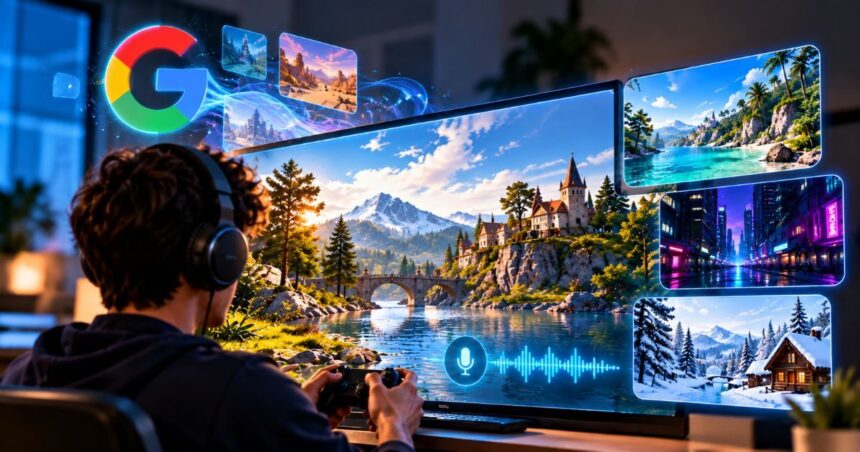
Google DeepMind has introduced Genie 4, a new AI world model designed to generate interactive virtual environments that respond to user actions in real time. Unlike conventional AI video generators that produce a fixed clip, Genie 4 lets users move through a scene, change elements using text prompts and hear sounds generated as the environment evolves.
Announced on October 27, 2026, Genie 4 builds on Google’s Gemini family of models. It aims to make simulated environments more realistic, with natural movement, changing scenes, ambient sounds, music and interactive dialogue.
The technology is still in its early stages. Google has started testing Genie 4 with a limited group of trusted testers, with access planned for Google AI Ultra subscribers through Project Genie and selected partners using the Gemini API and Google AI Studio.



What Is Google Genie 4?
Today we’re introducing Genie 4 — our newest interactive world model from @GoogleDeepMind 🌐 https://t.co/iE4WEWZRN4
— Google (@Google) October 27, 2026Genie 4 is a world model: an AI system designed to simulate how an environment behaves as people or objects interact with it. Rather than simply generating a picture or video from a prompt, it attempts to create a scene that can be explored and changed.
For example, a user could start with a virtual outdoor environment and then ask to change the weather, introduce a character or adjust the camera view. The model generates the evolving scene while responding to the user’s actions.
Google says Genie 4 uses Gemini Omni to help anchor the simulated worlds in realistic appearances and behaviour. Other Gemini models contribute reasoning capabilities intended to help the environment remain coherent as events unfold.
This approach could eventually make it easier to create interactive experiences without building every environment manually.
Real-Time Audio Makes the Experience More Immersive
One of Genie 4’s main additions is native audio generation. The model can produce sounds that accompany the environment, including background ambience, music and dialogue.
That matters because interactive worlds need more than convincing visuals. Sound can help make a simulated space feel alive, provide feedback when a user interacts with an object and make character interactions more natural.
Google’s demonstrations show audio being generated as part of the simulation rather than simply adding a soundtrack to a finished video. The company is also working on how scenes, movement and sound remain connected as users change what is happening.
However, this is not yet equivalent to a fully developed game engine or a production-ready virtual world. Audio accuracy and consistency remain areas of active research.
How Genie 4 Could Be Used
Although the technology is not yet broadly available, its potential uses extend beyond entertainment.
Gaming and interactive storytelling: Developers could use AI-generated environments to explore game concepts, build prototypes or test interactive stories. Instead of manually designing every scene, creators could start with a prompt and refine the environment through interaction.
Film and creative production: Filmmakers and visual artists could experiment with virtual locations, camera movements and scene ideas before committing resources to a full production. The technology may also help teams explore different versions of a setting quickly.
Robotics and AI agents: Simulated environments can help researchers test how robots or software agents respond to changing conditions. Virtual testing could make it easier to examine edge cases that would be expensive, slow or unsafe to reproduce in the physical world.
Manufacturing and training: More advanced simulations could eventually help workers practise procedures or allow engineers to explore how systems respond to different conditions. These applications would require reliable physics, accurate environments and careful validation.
These are potential applications rather than guaranteed outcomes. Real-world usefulness will depend on how reliably the model represents objects, movement and cause-and-effect relationships.
How Genie 4 Differs From AI Video Generators
Traditional AI video generators primarily create a sequence of frames from a prompt. The output can look realistic, but the viewer generally watches the generated clip rather than controlling the world as it unfolds.
Genie 4 is designed around interaction. Users can navigate a scene and steer its development while the model generates what happens next.
| Feature | Conventional AI Video Generation | Google Genie 4 |
|---|---|---|
| Main purpose | Generate video clips | Simulate interactive environments |
| User interaction | Usually limited during generation | Real-time controls and text prompts |
| Scene changes | Often require a new generation | Can be steered while interacting |
| Audio | Depends on the tool and workflow | Native audio generation |
| Potential uses | Videos, ads and creative content | Interactive experiences, research and simulation |
| Availability | Varies by product | Limited research preview, with wider access planned |
The distinction is important: Genie 4 is not simply another tool for generating AI videos. Its longer-term ambition is to model how a virtual world changes when something happens inside it.
What Are Genie 4’s Limitations?
Google acknowledges that Genie 4 remains an evolving research project. Although it can maintain coherent environments during shorter sessions, details may drift as a simulation continues or after users make multiple complex changes.
The company also identifies challenges involving physical interactions, spatial accuracy, legible text, real-time audio and long-term consistency. These limitations matter because a world that looks convincing in a short demonstration may behave unpredictably during extended use.
For applications such as robotics training or industrial simulation, visual realism alone is not enough. The environment must also respond accurately to actions and physical conditions. Researchers will need to establish how dependable Genie 4 is for each use case before it can be trusted in demanding settings.
When Can You Try Google Genie 4?
Google has begun rolling out Genie 4 as a research preview for trusted testers. The company plans to bring it to Google AI Ultra subscribers through Project Genie, along with early-access partners using the Gemini API and Google AI Studio.
This means most users cannot yet expect unrestricted access. Wider availability will depend on Google’s rollout plans, product readiness and the limitations of the preview.
Google has not positioned Genie 4 as a fully released consumer product. Readers interested in trying it should follow the official Google DeepMind announcement for access updates rather than relying on unofficial downloads or claims of open public availability.
Conclusion
Google Genie 4 points towards a different way of using generative AI: creating worlds people can explore and influence, rather than just images or videos they watch. Its real-time interaction and native audio make it an interesting development for gaming, creative work and simulation research.
For now, its limitations and restricted access are important. The next test will be whether Google can make these environments consistent, controllable and useful beyond short demonstrations.
Follow Us: Facebook | X | Instagram | YouTube | Pinterest