



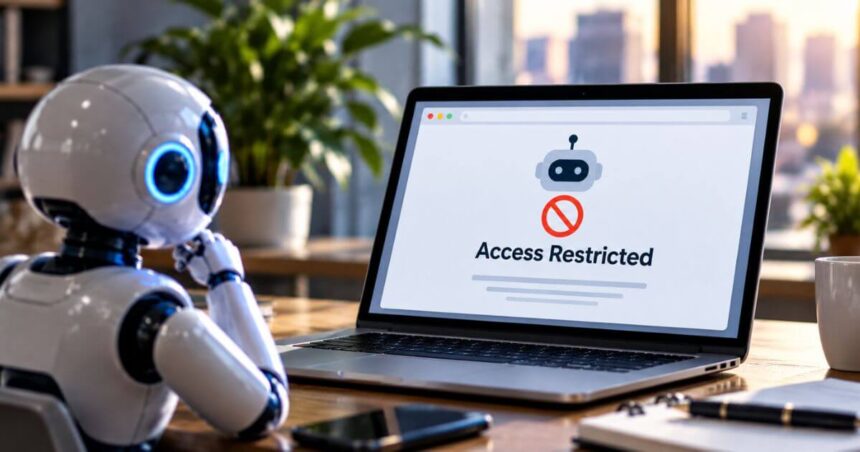
AI assistants are learning to do more than answer questions. They can search for products, navigate websites and help users complete tasks such as shopping or booking travel. But as these tools and AI agents become more capable, some businesses are restricting their access to online services.
The challenge is straightforward: an AI agent can only complete a task if the website it needs to use allows it to interact with its systems. Security policies, data licensing agreements and concerns about unauthorised activity are creating new barriers for autonomous AI tools.
Why Businesses Are Restricting AI Agents

Traditional chatbots mainly provide information or generate content. AI agents go a step further by taking actions on a user’s behalf. Depending on their permissions, they may navigate booking pages, compare products, manage information or attempt to complete purchases.



That ability introduces new risks for businesses. An agent could trigger an unintended transaction, access information in an unauthorised way or make repeated requests that put pressure on a website. Companies also want control over how their data is accessed and used by third-party services.
Several major businesses have already introduced restrictions. Yelp limits access for agents that have not joined its paid data-licensing programme. Delta Air Lines has said it does not currently have a partnership or integration that allows third-party agents to shop for or book flights through its digital platforms. JPMorgan Chase and Charles Schwab have also confirmed restrictions on AI agents accessing customer accounts over security concerns.
These measures do not amount to a universal ban on AI. Each business has its own policies, and some restrictions may also result from existing anti-bot systems that struggle to distinguish legitimate automation from suspicious activity.
The Battle Over AI-Powered Shopping
Online shopping is becoming one of the most visible areas of this conflict. AI assistants could help users compare products, discover alternatives and navigate checkout pages. However, retailers must decide whether they want third-party agents accessing their platforms and what those agents are permitted to do.
Amazon has challenged third-party AI shopping tools, including Perplexity’s shopping-related activities, raising questions about platform access and automated purchases. Other retailers are exploring more controlled arrangements. Meta, for example, has partnered with businesses including Walmart, Gap, Sephora and Best Buy for supported shopping experiences through its Muse assistant.
These approaches point towards a possible future in which AI agents interact with businesses through approved integrations rather than unrestricted website access. Such arrangements could make automation more predictable, but they may also mean that an assistant works with some retailers and not others.
What This Means For Indian Users
The issue matters to Indian consumers as AI tools increasingly promise to simplify everyday digital tasks. In the future, users may expect assistants to compare products across shopping platforms, organise travel plans or help manage online subscriptions.
Yet finding information and completing a transaction are two different things. An assistant might identify a suitable product but fail to complete checkout because the retailer blocks automated browsing. It might help prepare a travel booking without being able to confirm the reservation.
Users should also be careful about granting agents access to personal accounts. An AI tool with extensive permissions could expose private information or carry out actions with financial consequences. Use trusted services, review permissions and confirm important transactions directly through the relevant website or app.
Could AI Agents Work Better Through Official Integrations?
One possible solution is to create standardised ways for businesses and AI agents to communicate. Approved integrations could specify how an agent identifies itself, which information it can access and what actions it is allowed to perform.
This could benefit both sides. Businesses would gain more control over security and customer data, while AI developers could build more reliable experiences. Industry efforts to establish common ways for agents to interact with services are still developing, and universal compatibility is not guaranteed.
What The Restrictions Mean In Practice
| Area | Current Challenge | Potential Outcome |
|---|---|---|
| Online shopping | Retailers may block third-party agents | Some purchases may still require manual checkout |
| Travel bookings | Approved integrations may be unavailable | Agents may help plan trips without confirming bookings |
| Financial accounts | Banks restrict automated access | Users may need to manage sensitive tasks themselves |
| Business data | Licensing rules limit access | Some services may require authorised partnerships |
| Website security | Anti-bot systems can block legitimate automation | AI agents may not work consistently across websites |
Conclusion
AI agents could make online tasks faster and easier, but their success depends on more than the intelligence of the underlying model. Websites must also provide a secure and predictable way for these tools to interact with their services. Until access becomes more consistent, AI agents will remain useful assistants—but not dependable replacements for every online action.
Follow Us: Facebook | X | Instagram | YouTube | Pinterest