


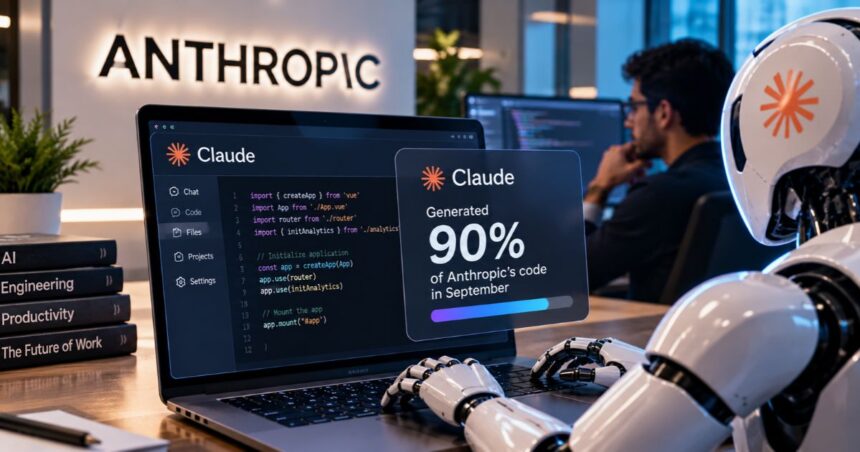
Anthropic is seeing the impact of AI-assisted coding inside its own engineering teams. The company says its Claude AI model contributed more than 90% of its codebase in September, highlighting how quickly software development is changing.
The figure comes from Anthropic’s registration statement filed with the US Securities and Exchange Commission (SEC) on October 26. The 335-page document outlines the company’s business ahead of a potential Nasdaq listing under the ticker symbol “ANT”. Reports suggest Anthropic could pursue a listing as early as next month.
Beyond its potential IPO, the filing offers a closer look at how Anthropic uses its own AI technology. Engineers are increasingly moving away from writing code line by line. Instead, they are spending more time directing Claude, evaluating its output and reviewing the code it generates.



Anthropic Reports A 45-Fold Rise In Daily Code Contributions

Anthropic’s filing highlights a significant increase in coding activity across its engineering teams. During the July-to-September quarter, the average number of daily code contributions per engineer was more than 45 times the average daily level recorded in 2024.
The company attributes much of this shift to the growing role of Claude in its development process. AI tools are taking on more coding tasks, allowing engineers to focus on reviewing results, guiding development and solving more complex problems.
The figures offer an indication of how AI is changing the work of software engineers. Rather than replacing every part of the development process, Claude is becoming a central tool that engineers use to produce and assess code at a much faster pace.
However, Anthropic’s reported figures do not mean that human engineers have become irrelevant. Reviewing AI-generated code and ensuring that it works as intended remain important responsibilities.
Claude Is Helping Anthropic Build Its Next AI Models
Anthropic is also using AI beyond everyday software development. The company describes its approach as “closing the loop”, where AI systems help research, design and develop the models that follow them.
According to the filing, Claude is being used to run experiments, generate training data, automate evaluations and support safety audits. The models have also helped identify algorithmic improvements that allow Anthropic to use its computing resources more effectively.
This creates a cycle in which AI assists the development of future AI systems. Claude is not only helping engineers write software but also supporting the research and testing processes required to improve the technology itself. “Claude itself has become one of the most powerful drivers of our progress,” Anthropic wrote in the filing.
The approach could help the company accelerate research and development. However, its success will depend on the quality of AI-generated work and the ability of engineers to evaluate the results.
Anthropic’s Hiring Strategy Is Also Changing
Anthropic’s growing reliance on AI comes as its workforce expands rapidly. The company had around 940 employees at the end of 2024. By late September, that figure had increased to approximately 5,300.
Despite this growth, Anthropic says it intends to expand its business without increasing its headcount at the same rate. AI-assisted workflows could allow existing employees to accomplish more without requiring a proportional increase in staffing.
The shift may also affect entry-level opportunities. An internal report cited in the available account indicated that Anthropic had been filling a smaller proportion of junior technical positions as AI agents increasingly handled tasks such as writing code and fixing bugs. This raises questions about how aspiring software engineers will gain practical experience if AI takes on more of the routine work traditionally assigned to junior developers.
Anthropic also reported regrettable attrition of approximately 1% for the 12 months ending September 30. The figure provides another detail about its workforce, although it does not establish a direct connection between employee departures and increased AI adoption.
Dario Amodei Had Predicted The Shift
Anthropic CEO Dario Amodei had previously predicted that AI would take on a much larger share of software development. In March 2025, he forecast that AI could write 90% of code within three to six months and potentially produce almost all code within a year.
By October 2025, Amodei said at Salesforce’s Dreamforce conference that Anthropic was already reaching the 90% threshold. He also suggested that AI-driven productivity could eventually increase demand for engineers, as individual developers become capable of accomplishing substantially more.
Boris Cherny, who leads Claude Code, has described an even more significant change in his own workflow. In June, he said he had gone approximately eight months without writing a line of code by hand. These examples show how AI is changing the role of developers, from manually producing code to guiding tools that can handle a growing share of implementation work.
AI Coding Comes With Risks
Anthropic’s filing also acknowledges the risks of relying heavily on AI systems. Among its listed risk factors, the company warns that its models could behave in unintended, misaligned or autonomous ways that could harm the business.
These concerns become increasingly important as AI takes on more complex tasks. A system that generates large amounts of code can accelerate development, but its output still needs to be tested, reviewed and monitored.
The challenge is not simply to increase the amount of code AI can produce. Companies must also ensure that the resulting software is reliable and secure, and that their systems behave as intended. For Anthropic, this is particularly significant because Claude is involved in developing the company’s future AI models as well as supporting its existing engineering operations.
Anthropic And Claude AI: Key Details
| Specification | Details |
|---|---|
| Company | Anthropic |
| AI Model | Claude |
| Reported Coding Contribution | More than 90% of the company’s codebase in September |
| Daily Code Contributions | More than 45 times the 2024 average per engineer |
| Reporting Period | July to September |
| SEC Filing Date | October 26, 2026 |
| Filing Length | 335 pages |
| Employees at End of 2024 | Approximately 940 |
| Employees by Late September | Approximately 5,300 |
| Potential Stock Ticker | ANT |
| AI Development Approach | “Closing the loop” |
| Key AI Applications | Coding, experiments, training data, evaluations and safety audits |
Conclusion
Anthropic’s latest filing shows how deeply Claude has become embedded in its engineering operations. With the company reporting that the model contributed more than 90% of its codebase in September, AI is no longer just an assistant for its developers. It has become a major part of how they work.
The change could allow engineers to focus more on system design, code reviews and complex technical challenges. At the same time, it raises concerns about entry-level hiring, the future responsibilities of developers and the risks of relying on increasingly capable AI systems.
The bigger question is how companies will balance faster development with human oversight. Anthropic’s experience offers a glimpse of what that future could look like, but the long-term effects on software engineering remain to be seen.
Follow Us: Facebook | X | Instagram | YouTube | Pinterest