




India is preparing for a major change in the way digital payments could work. A proposed framework may allow AI agents to make UPI payments on behalf of users without asking for approval for every individual transaction. The idea is to let users provide permission in advance and allow an AI agent to operate within clearly defined limits.
The framework is being developed around a proposed Unified Agent Protocol (UAP). If implemented, it could make UPI one of the first large national payment systems designed to support transactions initiated by AI agents. The initial focus is expected to be on small and routine purchases, rather than high-value transactions.
How AI Agent Payments Could Work
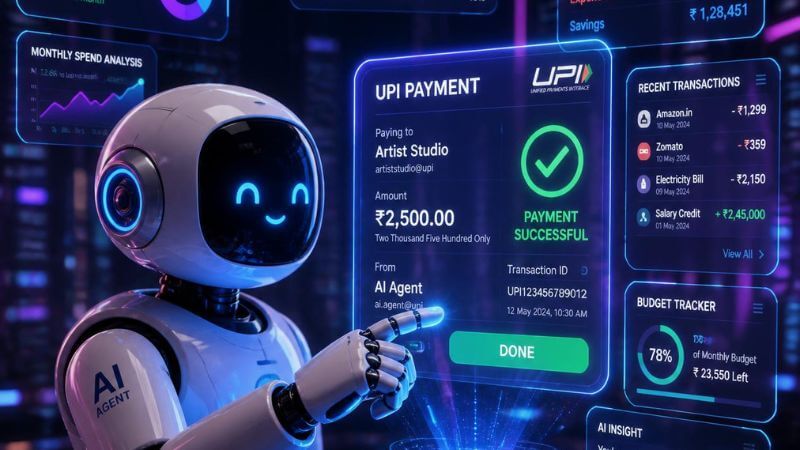
The biggest change is that users would not have to approve every payment manually. Instead, they could first tell an AI agent what it is allowed to do. For example, a user could allow an AI assistant to purchase groceries up to a particular amount. The user could also specify when the agent can make the payment or restrict it to certain types of purchases. The agent would then operate within those instructions.
More From Techotales



This could make AI assistants more useful for routine shopping. An agent could compare products, look for a suitable price and complete the purchase without stopping at the payment screen for another confirmation.
Small Payments Likely To Come First
The first use cases are expected to involve low-value and frequent transactions. Grocery shopping and routine online purchases are among the examples being discussed. This approach makes sense because consumers already make these payments regularly. Giving an AI agent limited authority could remove repetitive steps without immediately exposing large amounts of money to automated transactions.
The framework could eventually support more complex transactions. However, the initial rollout is expected to remain focused on smaller payments while the technology, security controls and liability framework are tested.
Spending Limits And Rules Will Be Important
Allowing an AI system to spend money without individual approval also creates new risks. An agent could misunderstand an instruction, select the wrong product or be manipulated by malicious information.
The proposed system is therefore expected to include several safeguards. These include spending limits, identity verification, rule-based instructions and audit trails. The idea is to make the user’s initial authorisation the key control. Instead of approving every payment, the user sets boundaries that determine what the AI can and cannot do.
The framework is also expected to address liability. This will be important if an AI agent makes an incorrect payment or a transaction is disputed. Banks, payment companies, merchants and AI platforms will need to know who is responsible when something goes wrong.
UPI Circle And Reserve Pay Could Support The System
The proposed framework could build on existing UPI capabilities instead of creating an entirely separate payment network. UPI Circle already provides a mechanism for delegated payments, while Reserve Pay can be used to set aside funds for future transactions. These features could provide some of the building blocks required for agentic payments.
A previous NPCI framework also enabled software and IoT devices to participate in delegated payment arrangements under UPI Circle. This gives the proposed AI-agent system an existing foundation within the UPI ecosystem.
India Is Joining The Agentic Payments Race
India is not alone in exploring AI-powered payments. Mastercard and Visa are working on agentic payment capabilities, while Pine Labs has developed an agentic protocol for UPI payments based on upfront authoriation.
There are also already experiments involving AI assistants and UPI. Razorpay and NPCI announced an agentic payments pilot with Claude earlier this year, allowing selected users to shop for food, groceries and everyday essentials through the AI experience. The proposed Unified Agent Protocol would take the concept further by creating a broader framework for AI-driven transactions across the UPI ecosystem.
What This Means For UPI Users
For consumers, the biggest benefit could be convenience. Instead of repeatedly searching for products, comparing prices and completing checkout themselves, users could delegate routine purchases to an AI agent.
Imagine setting a monthly grocery budget and allowing an AI assistant to automatically purchase selected products when prices meet a specific condition. The user would remain in control through predefined rules, while the AI would handle the repetitive work. But convenience will have to be balanced with security. The more authority an AI receives, the more important spending limits, identity verification and transaction monitoring become.
Conclusion
AI agents making UPI payments without individual approval could change how Indians interact with digital payments. The proposed Unified Agent Protocol aims to move UPI from a system where people initiate every transaction to one where authorised software can handle certain payments on their behalf.
The first applications are likely to focus on smaller purchases such as groceries and routine online shopping. If the system proves reliable, the range of use cases could expand. For now, the framework is still being developed and the final rules are not yet in place. The success of agentic UPI will ultimately depend on how well convenience, user control and payment security are balanced.
Follow Us: Facebook | X | Instagram | YouTube | Pinterest