
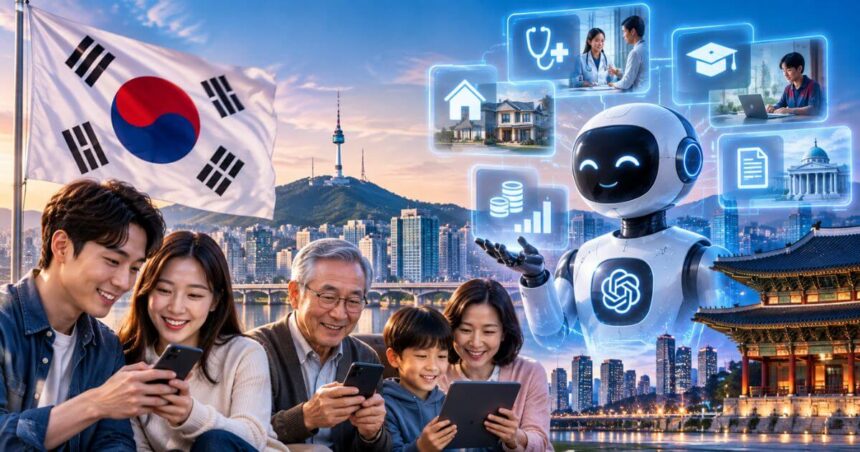
South Korea is taking an unusual approach to artificial intelligence. Instead of leaving AI access entirely to private companies and paid subscriptions, the government wants to make generative AI available to everyone. The initiative, called “AI for Everyone,” is designed to provide free access to general-purpose AI chatbots and agents across the country.
The Ministry of Science and ICT has selected three consortia led by SK Telecom, Kakao and KT to operate the service. The government plans to provide a total of 512 NVIDIA B200 GPUs to the selected operators this year. Agreements are expected to be signed in September, followed by beta services and a nationwide launch before the end of 2026.
South Korea Wants AI To Handle Everyday Tasks
The project goes beyond a conventional chatbot. The government wants the AI to help people complete everyday tasks, rather than simply answer questions. The planned services can cover areas such as government services, healthcare, finance, housing and education. Users could potentially search for information, compare options and then ask the AI to take the next step.


SK Telecom is developing an action-oriented AI that can take a request from planning through execution. It will be accessible through apps and the web, but also through phone calls and text messages. This could make the service more accessible to older people and users who are less comfortable with smartphones and apps.
The system could also contact businesses or government offices through phone calls when they do not offer digital interfaces. That is one of the more interesting parts of the project, as it attempts to connect AI with services that are still largely offline.
Three Companies Selected For The Project
The South Korean government initially received applications from six groups. After document and presentation evaluations, three were selected. SK Telecom, Kakao and KT will develop their own approaches while working within the government’s requirements. Each consortium brings its existing technology and distribution channels into the project.
Kakao plans to make KakaoTalk a major access point. Users could interact with a general-purpose chatbot and AI agents directly inside the messaging platform. KT plans to connect AI with services such as portals, shopping and real estate. Its proposed access points include Daum, Danawa, Musinsa, Zigbang and its own telecommunications and media platforms. This approach means users may not need to download a separate AI application to use the service.
512 NVIDIA B200 GPUs For Nationwide AI
Computing power will be an important part of the project. The government plans to provide the three selected operators with a combined 512 NVIDIA B200 GPUs during the initial phase. Starting in 2027, the government also plans to support the costs required to provide the service to the entire population. The scale is significant because the system is being designed for nationwide usage rather than a limited group of government employees or businesses.
The operators will also have to build infrastructure capable of handling large numbers of users. That includes the servers, networks and AI inference capacity needed to keep the service responsive as adoption grows.
South Korea Wants More Domestic AI Models
There is another important objective behind the programme. South Korea does not want its citizens to become completely dependent on AI platforms from overseas companies.
The selected services are required to use domestic AI models extensively. The government has set requirements that include using domestic models for more than 80% of the service, with at least 30% coming from domestic models developed by companies other than the operator. Foreign models can be used where they are considered necessary for specific advanced capabilities.
The move gives Korean AI companies a large potential user base while also giving the government greater control over its national AI infrastructure.
Aimed At Reducing The AI Divide
Affordability is another major reason for the programme. South Korea already has widespread AI adoption, but many people still use free versions of foreign services that come with usage restrictions. A government-backed service could remove the cost barrier and provide access without the same usage limits. Earlier government data cited in reporting showed that around 67% of respondents had experience using AI services, while 44.5% had experience with generative AI.
The idea is not simply to give people another chatbot. It is to make AI available regardless of income, age or digital experience.
Billions Are Being Invested In AI
The free AI programme is part of a much larger national investment. South Korea has allocated around 10 trillion won, or approximately $7.2 billion, for AI-related spending in 2026. The government sees widespread AI access as a way to accelerate adoption across citizens, businesses and public institutions. It is also part of a broader effort to strengthen South Korea’s domestic AI ecosystem and reduce dependence on foreign technology providers.
Conclusion
South Korea’s AI for Everyone programme could become an important test of whether AI can be treated as a public digital service rather than only a commercial product. The country is combining free access with domestic AI requirements and significant computing support. The challenge will be making the service reliable enough for millions of people while maintaining quality, privacy and security.
For now, South Korea is taking a clear position. AI should not be limited to people who can afford premium subscriptions or are comfortable navigating complicated technology. The government wants to put it within reach of everyone.
Follow Us: Facebook | X | Instagram | YouTube | Pinterest