



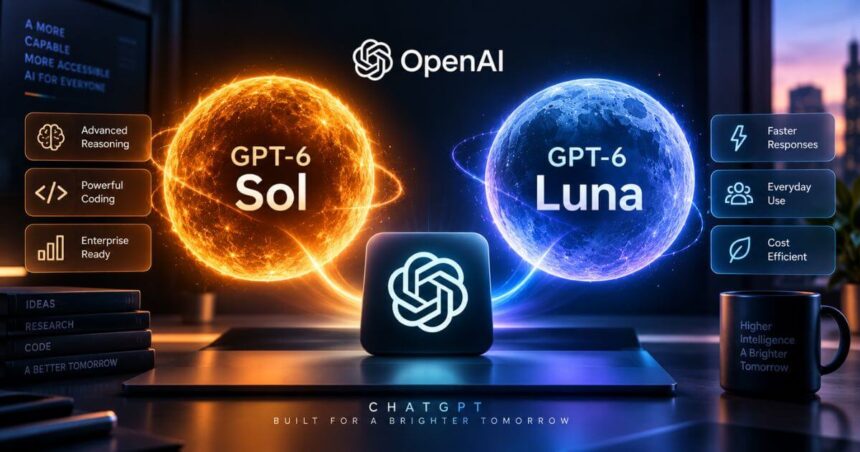
OpenAI has expanded its GPT-6 family with two new models, GPT-6 Sol and GPT-6 Luna. The new models are built on the same advances introduced with GPT-6 Astra, but focus more heavily on efficiency and cost.
GPT-6 Sol is aimed at demanding work such as coding, research, professional workflows and computer use. GPT-6 Luna is the lighter option. It is designed to deliver strong performance at a much lower cost and with faster responses. OpenAI says improvements in caching and inference have allowed it to cut API pricing for both models by 50% compared with GPT-5.6 promotional pricing.
GPT-6 Sol And Luna Bring Astra’s Advances To Lower-Cost Models
GPT‑6 Sol and Luna build on Astra’s advances in alignment, showing improvements over their GPT-5.6 counterparts. pic.twitter.com/1wlBRISIId
— OpenAI (@OpenAI) September 22, 2026OpenAI introduced GPT-6 Astra earlier this month as its most capable model. Sol and Luna extend that generation to users and developers who do not always need Astra’s full level of capability.



Both models were trained using similar methods to Astra. OpenAI says they bring improvements in professional work, factuality, coding, computer use and alignment. The focus is not simply on making the models smaller. It is about getting more useful work from every token and reducing the cost of running AI at scale.
GPT-6 Sol Focuses On Complex Work
GPT-6 Sol is positioned as the more capable of the two new models. It is designed for complex reasoning, professional workflows, coding and long-running agentic tasks.
On AutomationBench, OpenAI says GPT-6 Sol at xhigh effort scored 33.2%, compared with 26.9% for Claude Opus 5 at maximum effort. OpenAI’s reported cost per task was $0.27 for Sol, compared with 11.1 times that figure for Opus 5.
Sol also scored 56.4% on Agents’ Last Exam at maximum effort. OpenAI says this was achieved at 60% lower cost per task than Claude Opus 5’s highest score in the same evaluation.
These figures come from OpenAI’s own evaluations, so they should be viewed in that context. The company also notes that competitor results come from publicly available reports.
GPT-6 Luna Is Built For Everyday AI Work
GPT-6 Luna takes a different approach. It focuses on speed and cost efficiency while still offering improvements over GPT-5.6 Luna.
On AutomationBench, Luna at high effort improved by 5.4 percentage points over its predecessor while costing 58% less per task. OpenAI also says Luna at maximum effort reached 66.6% on DeepSWE, a software-engineering benchmark, while costing substantially less per task than the compared Claude models.
This makes Luna particularly relevant for applications where AI is used frequently. Developers can run more tasks without the API bill increasing at the same rate.
GPT-6 Sol And Luna Pricing
Higher usage limits and lower cost give you more flexibility and room to iterate. pic.twitter.com/AQJ5IlNsB1
— OpenAI (@OpenAI) September 22, 2026Pricing is arguably the biggest change with this release. GPT-6 Sol costs $2 per million input tokens and $10 per million output tokens. GPT-6 Luna costs just $0.10 per million input tokens and $0.50 per million output tokens.
For comparison, GPT-5.6 Sol was priced at $4 for input and $20 for output, while GPT-5.6 Luna cost $0.20 and $1.20 respectively under the promotional pricing referenced by OpenAI.
OpenAI has also improved prompt caching. Cached input-token reads receive a 90% discount, while better cache handling is designed to help agents reuse context across longer conversations and workflows.
GPT-6 Sol And Luna Specifications
| Specification | GPT-6 Sol | GPT-6 Luna |
|---|---|---|
| Positioning | High-performance model | Fast, cost-efficient model |
| Primary Use | Complex reasoning, coding, research, agents | Everyday AI, coding, scalable applications |
| Input Price | $2 / 1M tokens | $0.10 / 1M tokens |
| Output Price | $10 / 1M tokens | $0.50 / 1M tokens |
| Cached Input | $0.20 / 1M tokens | $0.01 / 1M tokens |
| Coding | Advanced coding and software engineering | Strong coding at lower cost |
| Computer Use | Advanced | Cost-efficient computer use |
| Factuality | About half as many mistakes as predecessor in OpenAI’s internal evaluation | Significant improvement over GPT-5.6 Luna |
| Reasoning Effort | Multiple effort levels, including xhigh | Multiple effort levels, including max |
| API Model ID | gpt-6-sol | gpt-6-luna |
| ChatGPT Availability | ChatGPT Work and Codex | ChatGPT Work, Codex and desktop access for Free/Go |
| Standard Chat | Not yet available | Not yet available |
OpenAI’s API documentation confirms that both models accept text and image inputs and generate text through the Responses and Chat Completions APIs.
Better Factuality, Coding And Computer Use
OpenAI says GPT-6 Sol makes about half as many mistakes as its predecessor in an internal factuality evaluation based on de-identified conversations where users had previously flagged errors. The company cautions that this evaluation is not representative of typical usage.
Coding has also received a major upgrade. On DeepSWE, GPT-6 Sol scored 68.8%, just 1.1 percentage points behind Claude Fable 5’s reported 69.9% result, while OpenAI says Sol cost approximately 80% less per task.
On OSWorld 2.0, Sol achieved 60.5%, compared with 60.3% for Claude Opus 5 at medium effort, again at around 80% lower cost per task according to OpenAI.
OpenAI has also brought Astra’s updated communication style to Sol and Luna. The company says users should see clearer responses, less jargon, fewer unnecessary details and shorter answers without losing substance.
GPT-6 Sol And Luna Availability
GPT-6 Sol and GPT-6 Luna are available in ChatGPT Work and Codex for Plus, Pro, Business, Enterprise and Edu users. Free and Go users can access GPT-6 Luna through the desktop app.
The models are not yet available in standard Chat. Developers can access them through the OpenAI API using gpt-6-sol and gpt-6-luna. OpenAI says the ChatGPT rollout is happening gradually.
Conclusion
GPT-6 Sol and Luna bring a different focus to OpenAI’s latest model family. Astra remains the company’s highest-capability option, while Sol targets demanding work at a lower cost and Luna pushes the price-performance equation even further.
The combination of lower API prices, improved caching, stronger coding, better factuality and more efficient computer use could make the two models particularly useful for developers and businesses running AI at scale. For everyday users, Luna’s lower compute requirements and faster experience could make advanced AI more accessible.
Follow Us: Facebook | X | Instagram | YouTube | Pinterest