



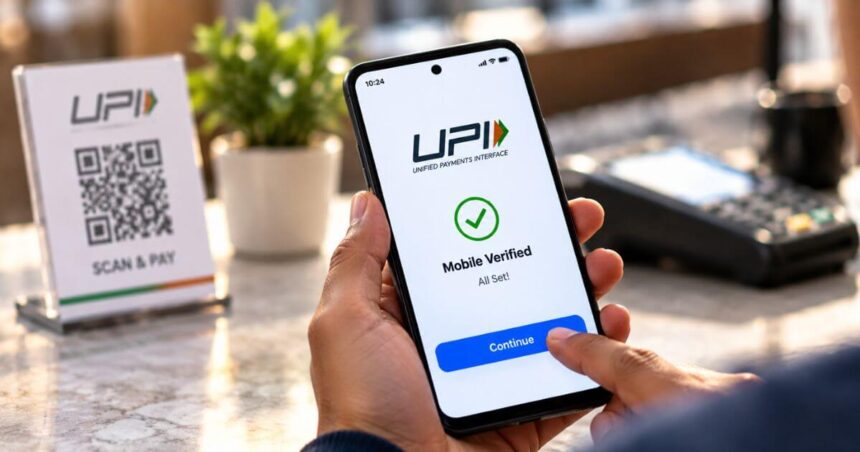
Registering a UPI app or linking a mobile number to a payment service often involves verifying that the number is associated with the phone being used. A new telecom-powered authentication method aims to make this process faster by checking the connection between a mobile number, SIM card and device without requiring an SMS one-time password for that particular verification step.
Bureau, a risk-decisioning company, has launched its Silent Mobile Verification (SMV) solution for India’s Unified Payments Interface (UPI) ecosystem. The launch follows an NPCI circular dated 30 September 2026 that, as described in the announcement, recognises this method as an alternative for UPI device binding.
What Is Silent Mobile Verification?
Silent Mobile Verification uses mobile-network information to check whether a submitted mobile number corresponds to the SIM associated with the device making a request.



In a typical SMS-based verification flow, a service sends an OTP or uses an SMS-based process to confirm access to a mobile number. With SMV, the verification instead relies on telecom-network information to return a match or no-match result.
Bureau says its system can return this result in under four seconds. The company identifies use cases including UPI registration, user onboarding, login, SIM binding and transaction authentication. These are provider-reported capabilities; they do not mean every UPI app currently supports the technology.
How The Verification Process Works
The process involves coordination between the service requesting verification and the relevant mobile-network operator. The requesting application securely shares the user’s mobile number and device IP address with Bureau. Bureau then coordinates with the relevant operator, which checks whether the submitted number corresponds to the SIM associated with the requesting device. The result is returned as a match or no-match response.
If implemented by a participating service, this process could reduce the need to wait for or manually enter an SMS OTP during the relevant device-verification step.
That does not mean authentication disappears. The system still performs a verification check; it simply uses a different method to establish the association between the mobile number, SIM and device. The exact process and any additional checks will depend on how each service implements it.
What NPCI’s Circular Means
The launch follows NPCI circular OC-238, dated 30 September 2026. The circular is described as recognising Silent Mobile Verification as an alternative to SMS-based device binding within the UPI framework.
Device binding helps establish that a UPI account or application is being registered on an appropriate device. A telecom-based check could provide another way for participating providers to verify this association.
However, recognition within a framework does not mean every UPI app has already adopted the technology. Availability will depend on implementation by relevant banks, payment service providers and app operators. Users should continue following the registration and security instructions shown by their own UPI app.
Could This Make UPI Safer?
Reducing dependence on SMS OTPs for a specific step could improve convenience and provide payment providers with another signal for fraud detection. A verified link between a mobile number, SIM and device may help assess whether a registration or login attempt appears legitimate. Bureau says its solution has more than 96% coverage across India’s three leading mobile operators and processes over three million transactions daily across more than 20 live enterprises. These are company-reported figures, not proof that all UPI transactions are covered by SMV.
The technology also has limits. A match between a mobile number, SIM and device does not establish a user’s full identity or prove that a payment is legitimate. Fraudsters can still exploit compromised accounts, social engineering and deceptive payment requests. SMV should therefore be viewed as one part of a wider security system. It does not replace Know Your Customer (KYC) requirements, identity checks or comprehensive fraud-risk assessment.
What UPI Users Should Know
For ordinary users, the potential benefit is a smoother registration or verification experience. If a participating app adopts SMV, a particular step may be completed without waiting for an SMS OTP. A few precautions remain important:
- Availability may vary: Not every UPI app will necessarily offer the method immediately.
- Protect your UPI PIN: Telecom-based device verification does not remove the need to keep payment credentials private.
- Check payment requests: Faster registration does not make every transaction or payment request trustworthy.
- Use official apps: Do not install unfamiliar applications or disclose sensitive information because someone claims to offer a new verification method.
SMS OTP Verification And Silent Mobile Verification Compared
| Feature | SMS OTP-Based Verification | Silent Mobile Verification |
|---|---|---|
| Main Method | Uses an SMS-based one-time password | Uses mobile-network information |
| User Interaction | May require receiving or entering an OTP | Can return a result without manual OTP entry |
| Verification Outcome | Confirms access to the mobile-number verification channel | Checks the association between the number, SIM and requesting device |
| Speed | Depends partly on message delivery and the verification flow | Bureau says results can arrive in under four seconds |
| Security Role | One verification method within a wider security process | An alternative or additional device-binding method |
| Availability | Depends on the service’s existing implementation | Depends on provider adoption and integration |
Note: This comparison describes the general approaches reported for SMV. Actual authentication flows and safeguards can vary by provider
Conclusion
Silent Mobile Verification could make parts of UPI registration and device verification faster while giving payment providers another signal for fraud prevention. Its practical impact will depend on adoption across India’s payments ecosystem. For now, it is best understood as an alternative verification approach for a specific step—not a replacement for every OTP, KYC requirement or UPI security measure.
Follow Us: Facebook | X | Instagram | YouTube | Pinterest