

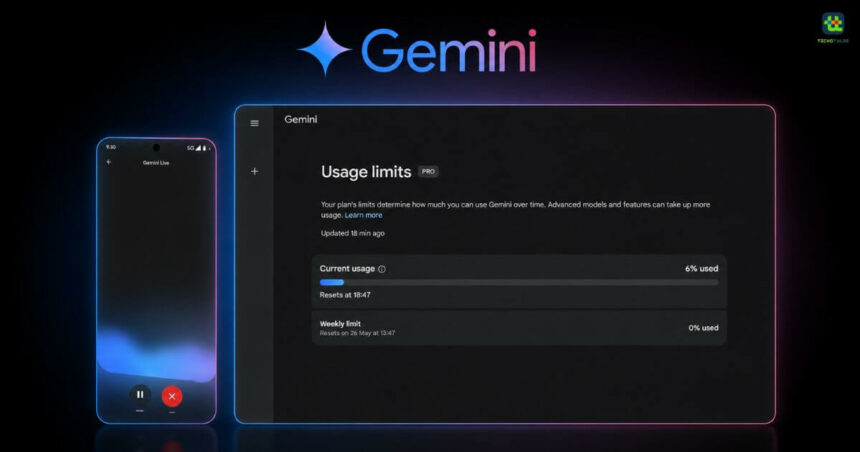
Google has quietly started rolling out a new usage dashboard for Google Gemini users, and the update brings both transparency and restrictions at the same time. The new dashboard allows users to track how much of their AI usage quota they have consumed, helping them understand when they are close to hitting rate limits.
However, alongside this useful addition, Google has also introduced a new weekly usage limit. Until now, Gemini mainly operated with a five-hour usage reset system, but the company is now adding broader restrictions that apply across an entire week. The update appears to be rolling out gradually worldwide, although Google has not officially announced it yet.
Gemini Gets A New Usage Dashboard
More Read

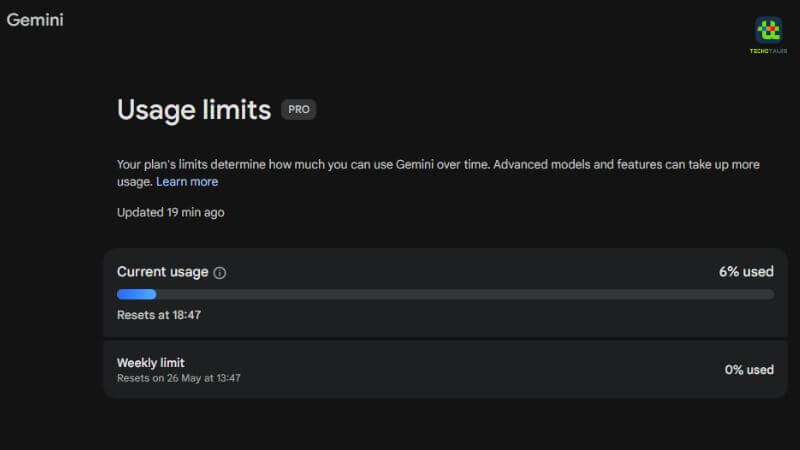
The new feature is called “Usage limits,” and it acts as a dedicated space where users can monitor their Gemini usage in real time. Reports suggest that Google is adding a new button inside the Gemini app and website interface that opens this dashboard. Some users have already started seeing it, while we Techotales can reportedly access it directly through the URL when logged into our Google account.
The dashboard is designed to improve transparency, especially for users who frequently hit usage limits and are forced to wait for resets.
What The Dashboard Shows
The new Gemini usage page includes two different tracking bars.
- A Current Usage bar
- A Weekly Limit bar
The current usage tracker resets every five hours, which has been the existing Gemini system since launch. The weekly tracker, however, is a completely new addition.
Both bars visually show how much of the assigned quota has already been used out of 100 percent.
This makes it easier for users to manage prompts and avoid sudden interruptions while using advanced AI tools.
Weekly Limit Is The Biggest Change

The five-hour rate limit is not new. But the weekly limit changes how users access Gemini over a longer period.
This broader restriction appears to be Google’s way of managing rising compute costs and balancing server demand across different subscription tiers.
In simple terms, users may now need to monitor not just short-term usage, but also their total weekly AI activity.
This also places Google in line with other major AI companies that have already started implementing stricter usage throttling.
Similar Trend Seen Across AI Industry
Google is not the first company to introduce broader quota systems for AI tools.
Last year, Anthropic introduced weekly quota restrictions shortly after launching Claude Code. Other AI platforms have also started limiting advanced feature access to control infrastructure costs.
The growing popularity of AI tools has dramatically increased demand for computing resources. As a result, companies are gradually shifting toward tier-based access systems.
Different Access Based On Subscription Tier
Google’s new usage system will vary depending on the subscription plan.
Users on higher tiers are expected to receive better access limits compared to free users.
The access hierarchy currently includes:
- Free tier
- Plus tier
- Pro tier
- Ultra tier
Free-tier users will receive the most limited access, while paid subscribers will get progressively higher quotas and feature availability.
What Free Tier Users Get
According to Google’s support information, free-tier users still receive access to several Gemini features, although usage remains restricted.
Some of the available features include:
- Basic access to Gemini 3.1 Pro and Thinking models
- General access to the Fast model
- Five screen automation requests
- Twenty audio overviews
- Five Deep Research reports
- Twenty AI image generations using Nano Banana 2
- Ten AI-generated music tracks
However, Google has also clarified that these limits can change anytime depending on testing, experimentation, or system availability.
Why Google Is Adding Limits
The biggest reason behind these restrictions is likely infrastructure cost management.
Advanced AI models require massive computational power, especially when handling large-scale user demand. Features such as image generation, reasoning models, and research tools consume far more resources compared to basic prompts.
By introducing weekly quotas, Google can:
- Reduce server overload
- Optimise compute allocation
- Differentiate subscription tiers
- Encourage upgrades to paid plans
This also helps the company maintain smoother performance during high-traffic periods.
Transparency Is A Positive Addition
Despite the restrictions, the usage dashboard itself is a useful feature.
Earlier, many users had no idea how close they were to exhausting their quota. This often caused interruptions during important tasks.
Now, users can monitor their usage more clearly and plan accordingly.
The dashboard adds:
- Better visibility into AI consumption
- Clear tracking of quota usage
- Improved planning for heavy users
- More transparency across subscription plans
Conclusion
Google’s new Gemini usage dashboard is both helpful and restrictive at the same time. On one side, it finally gives users a transparent way to track usage and avoid unexpected limits. On the other, the introduction of weekly quotas signals that AI platforms are becoming more controlled as demand continues to rise.
The move also shows how the AI industry is evolving. As advanced AI tools become more powerful, companies are increasingly balancing accessibility with infrastructure limitations.
For regular users, the dashboard will make quota management easier. But for heavy AI users, the new weekly limits could become an important factor while choosing subscription plans.
Follow Us: Facebook | X | Instagram | YouTube | Pinterest