

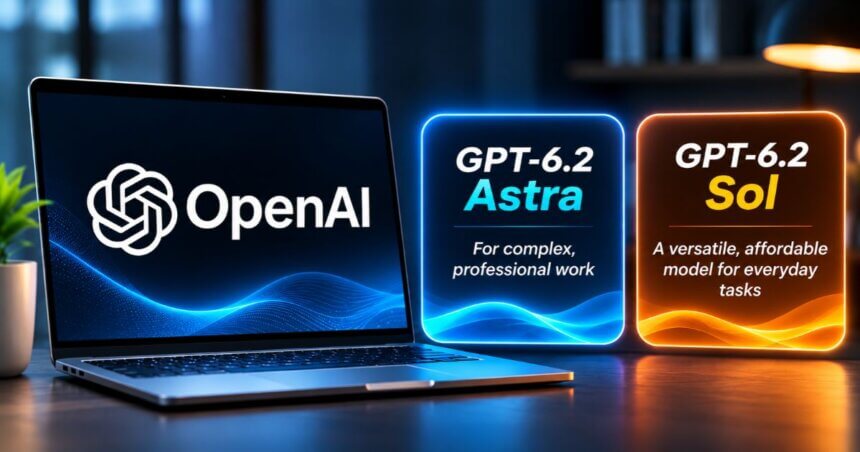
OpenAI has introduced GPT-6.2, its latest model update, with two new models called GPT-6.2 Astra and GPT-6.2 Sol. Announced on November 17, 2026, the release focuses on improving the way AI handles professional tasks, software development, research and everyday work.
- GPT-6.2 Astra Is Built For Complex Professional Work
- GPT-6.2 Sol Focuses On Everyday AI Tasks
- Better Coding, 3D Design And Computer Use
- OpenAI Highlights Improved Cybersecurity Capabilities
- GPT-6.2 API Pricing: How Much Does It Cost?
- GPT-6.2 Availability: Not Yet In Regular ChatGPT
- GPT-6.2 Astra Vs GPT-6.2 Sol: Key Differences
- Conclusion
Unlike a typical model upgrade that mainly promises better answers, OpenAI is putting considerable emphasis on efficiency. Both models are designed to complete demanding tasks with fewer output tokens, which can reduce costs and help users get more work done within their existing usage limits.
The two models also serve different purposes. GPT-6.2 Astra is designed for complex projects that require deeper reasoning, while GPT-6.2 Sol is positioned as a more affordable and versatile option for everyday work.



GPT-6.2 Astra Is Built For Complex Professional Work
Some of you have been asking very politely. Some of you have just been asking.
GPT-6.2 Astra and Sol are now available.
Super efficient and built to perform where it counts—the real world.
https://t.co/qr2iP0GpfX https://t.co/jLCyVIws2Y
— OpenAI (@OpenAI) November 17, 2026GPT-6.2 Astra is the more powerful model in the new lineup. OpenAI is positioning it for tasks that require detailed analysis, planning and multiple steps to reach a final result. One of its biggest improvements is in creating professional documents, presentations and spreadsheets. The model can follow an existing template more closely, including its layout, colours, typography and writing style.
For example, users can provide an existing presentation or even a screenshot of a slide template and ask Astra to create a new presentation in the same format. OpenAI says the model can reproduce layouts down to the font size while making slide titles clearer and the content more focused.
The improvements also extend to financial modelling and legal research. Astra can analyse source documents, identify relevant information and turn it into structured reports, financial workbooks and research-based documents. OpenAI says Astra scored 6.2 percentage points higher than GPT-6 Astra on its internal GDPval v2 benchmark while using 22% fewer output tokens. It also reported improvements in scientific research and legal-work evaluations.
These are OpenAI’s own benchmark results, so they should be treated as the company’s performance claims rather than independent proof that Astra is the best model for every professional task.
GPT-6.2 Sol Focuses On Everyday AI Tasks
GPT-6.2 Astra—a frontier model built for your hardest projects. It sets new highs on evals across professional work and scientific research at less than a third of the cost per task of GPT‑6 Astra.
You’ll see the difference in things like slideshows, websites, and 3D designs. pic.twitter.com/FcbBmZtbpF
— OpenAI (@OpenAI) November 17, 2026While Astra is designed for more demanding work, GPT-6.2 Sol targets users who need a capable AI assistant for regular tasks. It is designed to handle writing, coding, project planning, research and multi-step workflows without the higher cost associated with the flagship model.
OpenAI says Sol has improved considerably over GPT-6.1 Sol. On Cognition’s FrontierCode 2.0 evaluation, which checks whether AI-generated code changes meet the standards required for merging into real software projects, Sol came within 0.5 points of Astra while costing around one-fifth as much in the tested configuration.
The model also improves on OpenAI’s LifeVal evaluation, which measures how well AI handles practical everyday tasks, such as comparing homes based on budget and commute or planning meals around individual requirements. For most users who do not need the deepest reasoning available, Sol could become the more practical choice.
Better Coding, 3D Design And Computer Use
Coding and computer interaction are two areas where OpenAI is highlighting meaningful improvements. GPT-6.2 Astra is designed to work more effectively with existing codebases, implement complex changes and run focused tests. OpenAI says the model has better judgement when deciding which tools to use and how much effort a task requires.
The improvements are not limited to software development. Astra can also work with CAD and simulation tools, create 3D models and help engineers test design changes before building physical prototypes. OpenAI demonstrated how the model created a vehicle suspension simulation using a 3D model and a Python solver, then animated the results in Blender.
Both Astra and Sol can also turn written instructions into interactive browser experiences. These could include playable games, interactive visualisations and 3D environments. This suggests that OpenAI wants its models to do more than generate text or code. The broader goal is to make them useful for completing work across different applications and tools.
OpenAI Highlights Improved Cybersecurity Capabilities
Another important part of the GPT-6.2 release is cybersecurity. OpenAI says both models are better at identifying software vulnerabilities, writing more secure code and generating patches that fix security issues without affecting intended functionality.
However, these capabilities also create risks. More capable AI models could potentially make it easier for malicious users to discover and exploit vulnerabilities. OpenAI says GPT-6.2 Astra and Sol meet its Critical threshold for cybersecurity capabilities. The company has therefore introduced tighter safeguards for higher-risk cybersecurity requests.
The company also says Astra meets the High threshold for AI self-improvement, making it its first externally released model to reach that classification. This refers to the model’s ability to assist with AI research and development, which could potentially accelerate progress in future AI systems. OpenAI says it has strengthened monitoring, restrictions and oversight systems alongside the release.
GPT-6.2 API Pricing: How Much Does It Cost?
OpenAI has also adjusted the pricing of its latest models. GPT-6.2 Astra is cheaper than GPT-6 Astra, with a 20% reduction in standard input and output token prices and a 60% reduction in cached input pricing. GPT-6.2 Sol retains the same API pricing as GPT-6.1 Sol.
| Model | Input (per 1M tokens) | Cached Input | Output |
|---|---|---|---|
| GPT-6.2 Astra | $8 | $0.40 | $40 |
| GPT-6.2 Sol | $2 | $0.10 | $10 |
| GPT-6 Astra | $10 | $1 | $50 |
| GPT-6.1 Sol | $2 | $0.10 | $10 |
The pricing is particularly relevant for developers and businesses that run AI-powered applications at scale. Lower token costs can make it more affordable to run coding agents, research assistants and other automated workflows.
GPT-6.2 Availability: Not Yet In Regular ChatGPT
There is an important detail users should understand before looking for the new models. GPT-6.2 Astra and Sol are available through ChatGPT Work and Codex for eligible paid users, as well as through the OpenAI API. Enterprise and Edu access may require the workspace administrator to enable the models.
However, OpenAI’s release notes clarify that this rollout does not add GPT-6.2 Astra or Sol to regular ChatGPT conversations. This means users should not expect to find both models in the standard Chat model picker immediately. They are currently focused on the Work and Codex experiences, where users can handle longer tasks, create files and work with tools. OpenAI is also introducing its Ultrafast mode for eligible subscribers. Pro 500 users can use it with both models, while Pro 200 users get access with GPT-6.2 Sol.
GPT-6.2 Astra Vs GPT-6.2 Sol: Key Differences
| Feature | GPT-6.2 Astra | GPT-6.2 Sol |
|---|---|---|
| Primary focus | Complex professional work | Everyday tasks |
| Reasoning | Higher-end | Efficient |
| Coding | Advanced software engineering | Regular and multi-step coding |
| Documents | Advanced reports and presentations | Everyday writing and editing |
| Research | Scientific and professional research | General research |
| API input price | $8 per million tokens | $2 per million tokens |
| API output price | $40 per million tokens | $10 per million tokens |
| Best suited for | Businesses, researchers and complex projects | Developers and everyday workflows |
Conclusion
With GPT-6.2 Astra and Sol, OpenAI is making a clear move towards AI models that can complete real work rather than simply respond to prompts.
Astra brings improvements for complex professional projects, research, coding and design, while Sol offers a more affordable option for everyday tasks. The reduction in token usage and API pricing could also make these models more attractive to businesses and developers.
However, the current availability limitation is worth remembering. GPT-6.2 has arrived in ChatGPT Work, Codex and the API, but it has not yet replaced the models available in regular ChatGPT conversations. The next big question is how these models perform in independent real-world testing and whether their efficiency improvements translate into a noticeable difference for everyday users.
Follow Us: Facebook | X | Instagram | YouTube | Pinterest