

The artificial intelligence industry is entering a new phase. Until recently, companies competed to build one powerful AI model capable of answering questions, writing code, analysing documents and handling complex reasoning. That approach is now changing.
- Why One AI Model Is No Longer Enough
- Google, OpenAI And Anthropic Are Taking Different Approaches
- Google: Different Gemini Models For Different Workloads
- OpenAI: Balancing Advanced Reasoning And Speed
- Anthropic: Focusing On Capabilities And AI Safety
- Google Vs OpenAI Vs Anthropic: How Their AI Models Differ
- Rising AI Costs Are Driving This Change
- What This Means For AI Users
- Conclusion
Google, OpenAI and Anthropic are increasingly developing different AI models for different tasks. Some focus on advanced reasoning and complex coding, while others prioritise speed, affordability and everyday workloads. The change is not just about making chatbots smarter. Rising AI infrastructure costs, growing demand for AI agents and the need for faster responses are forcing companies to rethink how their models work. Here’s why the biggest AI companies are moving towards specialised models.
Why One AI Model Is No Longer Enough

Not every AI task requires the same level of intelligence. Writing a short email, summarising a document or answering a basic question does not require the same computing power as analysing a large codebase or completing a complicated research assignment. Using the most powerful model for every request can increase costs and response times unnecessarily.



This is why AI companies are developing multiple models with different capabilities. Users can get a faster, cheaper model for routine tasks and switch to a more capable model when the work becomes complicated.
The growing use of AI agents is another reason behind this shift. These systems can perform multiple steps, use tools and complete tasks with limited human intervention. Different stages of an AI workflow may require different levels of intelligence.
Google, OpenAI And Anthropic Are Taking Different Approaches
The latest model launches from the three companies show how this strategy is taking shape.
Google: Different Gemini Models For Different Workloads
Google is expanding its Gemini family with models designed for different requirements. Gemini 4 Neon focuses on complex coding, analytical reasoning and enterprise workloads. Gemini 4 Carbon targets demanding, longer-running projects, while Gemini 4 Hydrogen is designed for faster everyday execution.
The idea is to give developers and businesses more flexibility instead of sending every request to the most resource-intensive model.
OpenAI: Balancing Advanced Reasoning And Speed
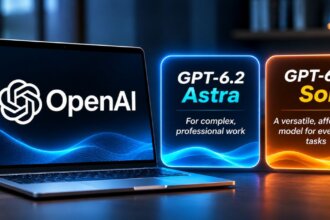
OpenAI is following a similar direction with its GPT-6.2 Astra and GPT-6.2 Sol models. GPT-6.2 Astra is positioned for advanced reasoning, complex coding and demanding professional tasks. GPT-6.2 Sol focuses on everyday coding and agent workflows, with greater emphasis on speed and cost efficiency. This gives users the option to select a model based on the complexity of their work.
Anthropic: Focusing On Capabilities And AI Safety
Anthropic is taking a slightly different approach with Claude Fable 5.2 and Claude Mythos 5.2. According to the company, both models share the same underlying model, but Fable includes additional cybersecurity and biology safeguards that allow broader access. Mythos, meanwhile, has more restricted availability through verification programmes.
This approach highlights another important consideration in AI development: powerful capabilities also require appropriate safety controls.
Google Vs OpenAI Vs Anthropic: How Their AI Models Differ
Here’s a quick look at how the latest model families are positioned by their developers.
| Company | AI Model | Primary Focus |
|---|---|---|
| Gemini 4 Neon | Complex coding and reasoning | |
| Gemini 4 Carbon | Long-running projects | |
| Gemini 4 Hydrogen | Fast everyday tasks | |
| OpenAI | GPT-6.2 Astra | Advanced reasoning and coding |
| OpenAI | GPT-6.2 Sol | Everyday coding and AI agents |
| Anthropic | Claude Fable 5.2 | Technical work with additional safeguards |
| Anthropic | Claude Mythos 5.2 | Advanced technical work with restricted access |
These descriptions reflect the companies’ positioning rather than an independent ranking of model performance.
Rising AI Costs Are Driving This Change
Building and operating powerful AI models requires expensive computing infrastructure. Every request consumes resources, and complex tasks can require significantly more processing. The financial pressure is becoming increasingly visible. A Capgemini Research Institute survey found that 61% of executives expect their organisations to adopt a multi-model AI strategy, selecting models according to cost, capability, speed and risk. The same research found that nearly three in five organisations had experienced significantly higher AI expenditure than expected.
AI agents are also becoming more common. McKinsey’s 2026 State of AI survey found that 40% of respondents from large organisations were scaling AI agents, compared with 27% in the previous year. These findings explain why businesses are looking beyond a single AI provider or model. They want the right balance between performance and operating costs.
What This Means For AI Users
This shift could make AI tools more practical and affordable. Users may increasingly get access to models that are specifically optimised for writing, coding, research, image generation or complex reasoning. Businesses could also use multiple models within the same workflow. A smaller model might handle document classification, while a more capable model takes care of analysis and decision-making.
However, choosing between multiple models could become more complicated. Users will need to understand which model works best for a particular task rather than automatically selecting the most expensive or powerful option.
Conclusion
Google, OpenAI and Anthropic are changing how AI models are developed and delivered. Instead of relying on one model to handle everything, they are building different options for different workloads.
The shift is being driven by rising computing costs, growing demand for AI agents and the need to balance intelligence with speed and affordability. Going forward, the biggest AI model may not always be the best choice. The real competition could be about delivering the right model for the right task at the right cost.
Follow Us: Facebook | X | Instagram | YouTube | Pinterest