

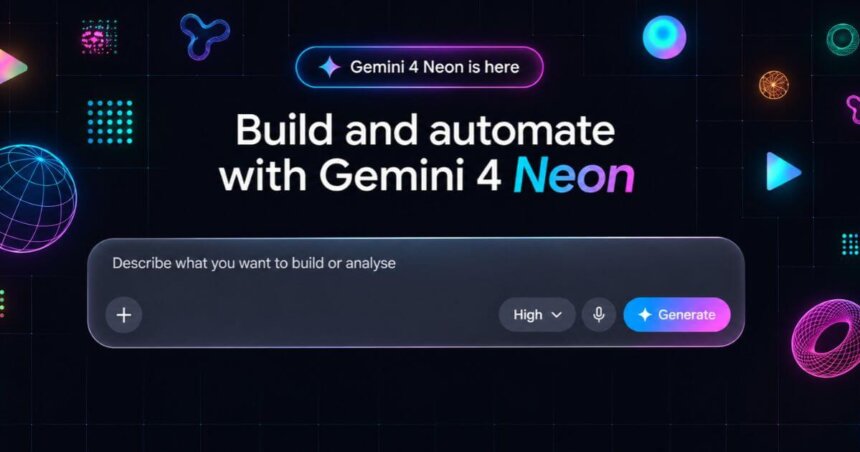
Google has expanded its Gemini 4 AI model family with the launch of Gemini 4 Neon. Announced on November 18, 2026, the new model is designed for complex coding, research, business analysis and other demanding workflows where users need strong reasoning without waiting for a larger model to complete every task.
- Gemini 4 Neon Brings a 1-Million-Token Context Window
- Better Coding and Long-Running AI Agent Workflows
- Gemini 4 Neon Benchmarks: What Google Claims
- Four Thinking Levels Give Users More Control
- Gemini 4 Neon Pricing: API Costs $3 Per Million Input Tokens
- Gemini 4 Neon Availability: Who Can Use It?
- Gemini 4 Neon vs Carbon vs Hydrogen
- Conclusion
The interesting part is where Neon fits into Google’s model lineup. Gemini 4 Carbon remains the option for the most demanding, long-running projects, while Hydrogen focuses on faster everyday execution. Neon is positioned between the two, offering a balance of intelligence, speed and operating cost.
Google is also making a strong push around agent-based workflows. Gemini 4 Neon can work through multi-step tasks, use external tools and coordinate smaller AI agents inside Google Antigravity. This makes it more than a model designed simply to answer questions.



Gemini 4 Neon Brings a 1-Million-Token Context Window
One of the biggest features of Gemini 4 Neon is its 1-million-token context window. This allows the model to process large amounts of information within a single interaction. For businesses and professionals, this can be useful when working with lengthy PDFs, spreadsheets, charts, audio recordings and video files. Instead of splitting a large project into several smaller prompts, users can provide multiple sources and ask Neon to connect the information.
Google says the model can turn these inputs into structured reports, summaries and other useful deliverables. It can also use relevant information from connected Google services, including Gmail and Docs, when the user gives it access. This could make Neon particularly useful for financial analysis, research, legal work and business reporting, where the answer often depends on information scattered across different documents.
Better Coding and Long-Running AI Agent Workflows
Starting today, Gemini 4 Neon is available to Google AI Pro and Ultra subscribers on mobile, desktop, and web.
This new model excels at work that requires frontier-level reasoning and fast responses. 🧵
— Google Gemini (@GeminiApp) November 18, 2026Software development is another major focus of Gemini 4 Neon. Google says the model can handle multi-file debugging and refactoring across large code repositories, making targeted changes rather than rewriting unnecessary sections of a project. It is also designed for longer agent workflows. In Google Antigravity, Neon can operate independently or act as an orchestrator that directs multiple Gemini 4 Hydrogen subagents working in parallel. This approach allows different parts of a task to be handled simultaneously. Neon can coordinate the work, track progress and bring the results together.
Google has shared several demonstrations to show what this means in practice. In one example, a Neon-powered agent created an interactive 3D recreation of Alan Turing’s 1936 study using archival photographs. Another demonstration showed an agent swarm turning a single image into a Google Sheet containing 100,000 cells and more than 500,000 live formulas. These demonstrations highlight the model’s ability to combine coding, research and tool usage. However, they are examples selected by Google and should not be treated as a guarantee that every similar task will produce the same result.
Gemini 4 Neon Benchmarks: What Google Claims
Google says Gemini 4 Neon performs strongly across coding, scientific reasoning, business tasks and agent-based evaluations. The model scored 61 on the Artificial Analysis Intelligence Index at its xhigh thinking level, where Google says it ranks third overall. It also recorded 70.9% on the Vals Index and 65.2% on Terminal-Bench 4.1. For software development, Google reports a 46.2% score on FrontierCode 2.0 at the model’s default high setting. It also highlights a 39% result on SWE-sweep when tested inside Google Antigravity.
The model’s Agent Arena Index result is another notable figure. It debuted at number two with 1,336 points across more than 4,200 real-world agent sessions, according to Google. These numbers come from different evaluation systems and should not be compared as if they measure exactly the same capability. They do, however, show the areas Google wants Neon to compete in.
Four Thinking Levels Give Users More Control
Gemini 4 Neon introduces four thinking levels that allow users and developers to adjust how much reasoning the model applies to a task. The available levels are Low, Medium, High and xhigh. Lower settings are more suitable for tasks where speed and token efficiency matter, while higher settings provide more reasoning capacity for complex problems. This flexibility is important because not every request needs the same amount of computing power. A straightforward document summary does not require the same reasoning effort as debugging a large software project or analysing a complex scientific problem.
Google says that at its default High thinking level, Neon delivers a 32% lower cost per task than Gemini 4 Carbon in its evaluations. At xhigh, it can apply deeper reasoning to more demanding work. The Gemini app and API do not necessarily expose the same controls. The app offers Low, Medium and High, while the API provides the additional xhigh option.
Gemini 4 Neon Pricing: API Costs $3 Per Million Input Tokens
Pricing is one of the most important parts of the launch, particularly for developers and businesses that use AI models at scale.
Gemini 4 Neon costs $3 per million input tokens and $15 per million output tokens through the Gemini API. Cached input tokens cost $0.15 per million, which Google describes as a 95% discount compared with standard input pricing.
| Pricing component | Gemini 4 Neon |
|---|---|
| Input tokens | $3 per 1 million |
| Cached input tokens | $0.15 per 1 million |
| Output tokens | $15 per 1 million |
| Context window | 1 million tokens |
| Thinking levels | Low, Medium, High, xhigh |
| Free API tier | Not available |
Google is also highlighting the model’s cost per completed task rather than only its token price. According to the company’s evaluations, Neon can deliver similar or better quality than Carbon at a lower cost for several workloads.
An early evaluation shared by Glean, a workplace AI platform, found that Neon matched or exceeded Gemini 4 Carbon’s overall quality at three times the speed and 60% of the cost. This is a result from an early evaluation, not a universal performance guarantee across all applications.
Gemini 4 Neon Availability: Who Can Use It?
Gemini 4 Neon is rolling out across Google’s developer, enterprise and consumer platforms, but access depends on the product and subscription. Developers can access it through the paid Gemini API tier in Google AI Studio and Android Studio. Google AI Pro and Ultra subscribers can also try it in Google AI Studio and Google Antigravity.
For consumers, Gemini 4 Neon is available in the Gemini app to Google AI Pro and Ultra subscribers. Free users and Google AI Plus subscribers are not included in the initial Neon app rollout.
Businesses can access the model through Gemini for business, either through the API or the model dropdown. Google is also preparing a specialised cybersecurity version for trusted defenders participating in its Fairwind Program.
Gemini 4 Neon vs Carbon vs Hydrogen
Google’s latest model lineup is designed to give users different options depending on the complexity and speed requirements of their work.
| Feature | Gemini 4 Hydrogen | Gemini 4 Neon | Gemini 4 Carbon |
|---|---|---|---|
| Primary focus | Fast everyday execution | Balanced reasoning and efficiency | Most demanding projects |
| Coding | Everyday coding | Complex coding and debugging | Advanced long-horizon coding |
| Agent workflows | Fast execution | Orchestration and parallel agents | Complex long-running tasks |
| Context window | 1 million tokens | 1 million tokens | 1 million tokens |
| API input price | $1.50 per million | $3 per million | $4 per million |
| API output price | $7.50 per million | $15 per million | $20 per million |
The pricing above reflects the listed standard rates at the time of writing. Google’s pricing and model availability can change, so developers should check the current API pricing page before deploying a model.
Conclusion
With Gemini 4 Neon, Google is trying to address a practical problem in the AI market: powerful models can be expensive and slower to run, while cheaper models may struggle with complex work.
Neon aims to bridge that gap. Its combination of a 1-million-token context window, multi-step coding capabilities, agent orchestration and flexible thinking levels makes it an interesting option for developers and businesses.
The real test will be how consistently it performs outside Google’s demonstrations and benchmark evaluations. Still, the launch shows that Google’s AI strategy is increasingly focused not just on building more powerful models, but also on making advanced AI more efficient and practical for everyday professional work.
Follow Us: Facebook | X | Instagram | YouTube | Pinterest