
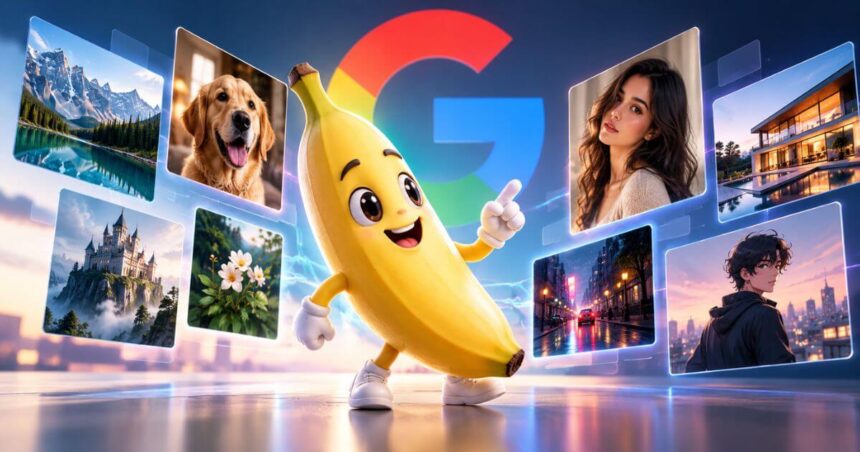
Google has launched Nano Banana 2.1, its latest AI model for image generation and editing. The new model focuses on better image quality, stronger prompt following and improved consistency when users edit or generate visuals. The biggest change, however, may be the price. Google says Nano Banana 2.1 can generate images for roughly half the cost of the previous-generation Nano Banana 2.
The model is positioned as a high-efficiency image generation and conversational editing model. It supports 1K, 2K and 4K image generation and can work with multiple reference images. It is also designed to produce better text inside images, which could make it more useful for posters, infographics and other professional visuals.
Nano Banana 2.1: What’s New?
Meet Nano Banana 2.1, our latest image generation and editing model 🍌
This upgraded version outperforms our previous models across the board, with notable leaps in visual design, mask-based editing, and subject consistency to help you create more natural-looking images.
— Google (@Google) October 6, 2026Nano Banana 2.1 builds on the capabilities of Nano Banana 2 but improves several areas. Google says the model delivers better visual quality and realism while maintaining Flash-level speed and cost efficiency. It also improves prompt adherence, meaning it should do a better job of following detailed instructions.


The model can generate images directly from text prompts. It can also edit existing visuals through natural-language instructions. Users can ask it to change clothes, replace a background, add or remove objects or modify the style of an image without starting over.
One of the more useful upgrades is its multi-image capability. Nano Banana 2.1 can accept up to 14 reference images. Google says it can maintain character consistency for up to four characters and object fidelity for up to 10 objects. This could be particularly useful for creators working on campaigns or a series of images where the same people or products need to remain consistent.
Better Text, Infographics And 4K Images
AI-generated text has traditionally been a weak point for image models. Nano Banana 2.1 aims to improve this area with enhanced text rendering and infographic layout accuracy. That makes it more suitable for posters, diagrams, charts, social media creatives and specification graphics.
The model supports 1K, 2K and 4K output resolutions. Google also says it has fixed tiling artefacts on wide and panoramic aspect ratios at 2K and 4K resolutions.
Another important addition is configurable thinking. Users can choose between minimal, medium and high thinking levels. Medium is the default option. This gives developers more control over how much processing the model uses for an image-generation request.
Google Search Grounding Comes to Nano Banana 2.1
Nano Banana 2.1 also supports grounding with Google Web and Image Search. This means the model can use information retrieved from Google Search when generating visuals.
This could be useful when users want to create images based on real-world information rather than relying only on the model’s internal knowledge. It can also help when a prompt requires current visual or factual context.
Google has made the model available through the Gemini API and Google AI Studio. The company is also rolling out Nano Banana 2.1 across its broader ecosystem, including Gemini and other products.
Nano Banana 2.1 Price Per Image
The biggest attraction for developers could be the lower image-generation cost. A 1K image generated through Nano Banana 2.1 costs approximately $0.0336 per image through the standard API pricing. A 4K image works out to around $0.0756 per image based on Google’s current token pricing for image output.
For comparison, Nano Banana 2 was priced at around $0.067 for a 1K image and $0.151 for a 4K image. That puts Nano Banana 2.1 at almost half the previous-generation cost for these resolutions.
For businesses and developers generating thousands of images, the difference can become significant. Lower costs could make large-scale image generation more practical for advertising, e-commerce, publishing and social media.
Nano Banana 2.1 Specifications
| Feature | Nano Banana 2.1 |
|---|---|
| Model ID | gemini-nano-banana-2.1 |
| Type | AI Image Generation & Editing |
| Input | Text, Image, Video, PDF |
| Output | Image, Text |
| Resolutions | 1K, 2K, 4K |
| Reference Images | Up to 14 |
| Character Consistency | Up to 4 characters |
| Object Fidelity | Up to 10 objects |
| Thinking Levels | Minimal, Medium, High |
| Search Grounding | Google Web & Image Search |
| API | Gemini API |
| 1K Image Cost | Around $0.0336 |
| 4K Image Cost | Around $0.0756 |
Google’s developer documentation identifies Nano Banana 2.1 as an update to Nano Banana 2 and lists it under the model ID gemini-nano-banana-2.1. It does not describe the model as simply another version of Gemini 3.6 Flash.
Conclusion
Nano Banana 2.1 looks like a practical upgrade rather than just another image-generation model. Better prompt following, stronger text rendering, multi-image consistency, Search grounding and 4K support make it more useful for serious creative work.
But the lower pricing could be the biggest story. At around half the previous-generation image cost, Nano Banana 2.1 gives developers more room to generate images at scale without dramatically increasing their budgets. For creators and businesses producing large volumes of visual content, that could make Google’s latest Nano Banana model a much more attractive option.
Follow Us: Facebook | X | Instagram | YouTube | Pinterest